
The Transformation of the Ideal Wilderness
From reading cities to reading the self—
Arriving at place as Devotion
By Kathleen Fogler
I’ve lived in a lot of places. Each one shaped me in ways I didn’t fully understand until later — much like a city, formed not by any single decision but by the slow accumulation of location, culture, and time.
Born in Northridge, California, I spent my earliest years in the LA area and Orange County — before it was “Orange County.” My earliest memories were of the landscape: days spent at the beach, giant oak trees lining narrow canyon roads, brown desert hills, palm trees, and lush pink bougainvillea vines climbing our fence line. As growth became explosive and crowds slowly gobbled up the land, my parents wanted something more fundamental than a longer commute to a quieter suburb. In 1993 we moved to Springfield, Missouri — on the Springfield Plateau, amidst the quiet hills of the Ozark Mountains — seeking real space, true tranquility, a grounded life that Southern California had made increasingly difficult to imagine.
Springfield and the Midwest were the opposite of Southern California in every way. I’ve always been thankful for this move, as it brought me down to earth and instilled a different value system — one of kindness and appreciation for the fundamentals of everyday life: home, family, school, sports, friends, effort, and peace in the every day. It also planted the question that has driven my entire career: how do you honor a place of deep beauty while confronting the forces that steadily erase it?
The Ozarks answered the first half of that question immediately. Limestone mountains draped in emerald green trees, spring times bursting with pink redbuds and white dogwood blossoms, graceful arching silhouettes of the hills at dusk, gently sweeping roads following the ridge lines through the woods and over the hilltops, two-lane farm roads stretching as far as I could see under blue sky and white clouds. Landscape was and is a calm, inspiring, peaceful force in my life, then and now. And yet I was always dissatisfied with the commercial strips and power centers — the epitome of economic trends and cycles playing out across the landscape, often in ways that completely erased that beauty. It was dry and disappointing, and so typical of most places, as I would later discover in planning school. The second half of the question — why, and how to change it — would take decades to answer.
The American city is a palimpsest. The land holds the record: prehistoric geology determines the drainage; early settlement follows the water; the railroad grid supersedes the river town; the highway supersedes the rail. Each era arrives with its own ideal about the wilderness — something to be conquered, cultivated, commodified, or conserved — and each leaves a layer. What fascinated me was never any single era in isolation, but the accumulation: how ideals compress into the land like strata, legible to anyone willing to slow down and look.
And so began my path toward becoming an architect, urbanist, and city planner. I found myself back in LA attending architecture school at USC, living downtown and enthralled with the city and its nontraditional forms. Does a city require a downtown with tall buildings to be a place? In fact, most places are about everything but their downtown. LA, for instance — the hills, the flats, the beaches — the ecology of the city is more dynamic and alluring than the skyline. The real city lives in its terrain.
Eight years later, I moved to Boston to attend graduate school, and was again immersed in a whole new environment and urban structure. Boston was a city already deep in its own transformation — from industrial heartland to knowledge economy — and yet its bones remained legible. The earliest town structure in American history, walkable and dense, paths following the least resistance along rivers and valleys, a town structure that had emerged from the landscape rather than being laid on top of it. Here was what Springfield might have been pointing toward all along: a city whose form was a direct expression of its terrain, whose streets remembered the routes of horses and water before they remembered the routes of cars.
Graduate school gave shape to the obsession. I discovered critical regionalism — a framework developed in response to the twin failures of modernism and postmodernism. Modernism had flattened the world into universal solutions, erasing local culture and terrain in the name of progress. Postmodernism pushed back, but too often retreated into nostalgia and pastiche, borrowing historical forms without their living roots. Critical regionalism offered a third path: architecture and urbanism that is fully of its time — technically sophisticated, forward-looking — yet deeply grounded in the specific history, climate, culture, and landscape of where it stands. As humans we are always moving forward; the question is whether we carry the depth of where we come from. That idea reoriented everything. My thesis, The Transformation of the Ideal Wilderness: A Case Study of Springfield, Missouri and Opportunities for Urbanism in the Mid-Size American City, took Springfield as its subject: an attempt to decode the place where I had grown up, to understand its potential by first understanding its layers.
The methodology that emerged was to read the city the way a geologist reads rock — not as a surface, but as a record. Physical structure and cultural systems in historical sequence, from prehistoric terrain through each era of growth, each era carrying its own set of ideals and values about the land, about wilderness, about what a good life looked like. Form and ideal, inseparable. It was rigorous, revelatory work — and it was still entirely in the third person. I was reading the values embedded in the landscape analytically, with great care, but from the outside. The idea that the same methodology might turn inward — that I might need to read my own layers with the same honesty I brought to Springfield’s — hadn’t arrived yet. What I didn’t yet know was that the transformation of the ideal wilderness is not only a story about cities. It is a story about the self.
After graduate school, I moved to Denver in 2012 and joined Tryba Architects to lead the urban design studio — learning what it actually takes to build a city. The civic enterprise of urbanism moves through many hands: vision and planning, urban design and public realm, entitlement and community engagement, ultimately resulting in civic architecture and inhabited place. Through that work, a design methodology crystallized. It has three movements.
Enter the Field. Before analysis, before drawing, before vision — be present in the place. Walk it. Feel its terrain, its textures, its rhythms of use and neglect. This is not preliminary work; it is the work. The body knows things the map cannot show.
Read the Record. Decode the deep structure: the prehistoric geology, the sequence of eras, the cultural values and ideals embedded in each layer of growth. Form and ideal are inseparable — to understand why a place looks the way it does, you must understand what its builders believed. Pattern, history, and aspiration are all legible to those who learn to look. Drawing by hand is the essential tool of this reading. To draw a place is to encounter it the way you encounter a book — but the book is written in space, in section and plan, in the sequence of moving through a street or a room. The hand traces what the eye perceives, and in the tracing, understanding deepens in ways no photograph or model can replicate. Field observation and hand drawing together are where all of my design thinking begins.
Project the Future. Honor what is. Improve what can be. Structure the future not by erasing the past but by extending its deepest logic forward — identifying the practical processes, tools, funding mechanisms, and partnerships that allow a vision to take on a life of its own, to be adopted and carried by many. The best project begins with what appears to be a blank piece of paper. There is no such thing. Every site already holds its story, its strata, its forward momentum. The work is to find it, and set it free.
Ideal Wilderness Studio is the distillation of that journey — twenty years of education and practice brought into a single, focused instrument. The work is about reintegrating cities and landscape, reconnecting people to the land, revealing the sustaining depth of place that is already present, waiting to be read. But the deeper I go, the more I understand that the transformation of the ideal wilderness is not only something we do to cities. It is something we undergo ourselves.
Place as Devotion
The methodology — Enter the Field, Read the Record, Project the Future — had always been grounded in embodied presence. But the longer I practiced, the more I felt the pull to deepen that embodiment not just as professional method but as a way of living. January 2024, I stopped driving to work and started walking. It wasn’t a philosophical statement — it was exhaustion. I hated the enclosure, the noise, the glass between me and everything passing outside. As life had gotten busier with children and family and practice, I had quietly abandoned my commitment to walking as primary transportation. What I lost was not exercise. It was the thread between my body and the world — the same thread I had first found doing field observations in Springfield, drawing streets by hand, reading the city with my feet and my pencil before I tried to understand it with my mind.
Returning to walking was returning to the most important instrument I have. The more I inhabit that practice — the more present and embodied I am — the better I design, the better I see, the better I am at everything that matters to me. That is not a theory. It is lived experience, and I trust it completely.
We can wait for the perfect city. We can aspire to the Italian village, the celebrated plaza, the boulevard of dreams — and we absolutely should. Beauty in the built environment is not a luxury; it is a form of collective care, and those of us who practice urbanism carry a genuine responsibility to pursue it. But I want to suggest something that runs alongside that ambition, something more intimate and more urgent:
place is also a personal practice. Place is a devotion. And devotion, by its nature, is both personal and collective — it begins in the individual and radiates outward, shaping the shared life of a community.
It is the relationship we build with places — with walks, with spaces, with corners and light and seasons — over time, through repeated interactions and accumulated memory. The longer I do it, the more I understand that it is not primarily about observation, though observation is part of it. It is about the commitment — day after day, showing up. Noticing the buds coming out on the branches. Knowing whether this spring is early or late. Recognizing the soft silver-gray tones of a winter sky giving way to something warmer. That is devotion. That is the same quality of presence that any great relationship requires: a romantic partner, a child, a community. It takes showing up. It takes love.
At this point in my life, I believe I can create place anywhere — if I take the time to be there, if I take the time to see. I walk down an ordinary commercial street as contemplatively as I walk through a celebrated park. The views are there if you know how to find them. This is not resignation. It is a more radical proposition: place is not simply delivered to us from the outside, that we are co-creators of every environment we inhabit.
Kevin Lynch understood this. The image of the city is never the city alone — it is the city as perceived, shaped by the paths people walk, the landmarks they claim, the edges they navigate. The city achieves legibility through use, through the repeated acts of thousands of people choosing to be present. In all the structures we have already built, there are unlimited places waiting — they simply require someone to visit them, find them, and in finding them, make them real. If a place exists but no one is devoted to it, is it truly a place at all?
Place is a personal and collective practice: it is made in the encounter between a self that is paying attention and a world that is always, quietly, offering itself.
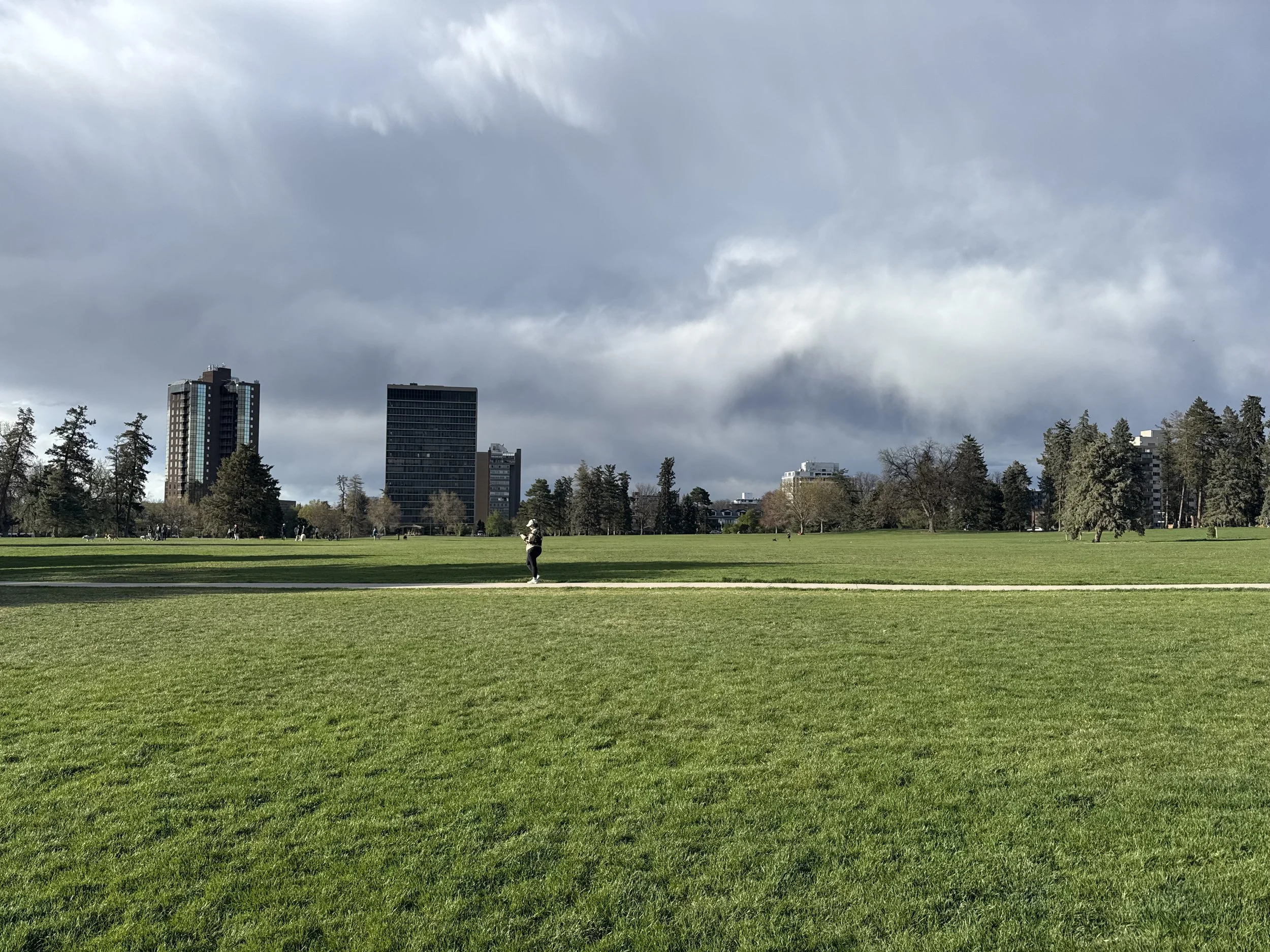
There is no hard boundary between what we see outside and what we carry within. On the open plain, in the wide field of the world, we are completely intertwined with our surroundings. When we are devoted — to our place, our environment, our people, our relationships — a wholeness can emerge that is so quiet you might almost miss it if you’re moving too fast. Grounding into place is grounding into the present. And the present, attended to with full devotion, is mysterious and wondrous — a space of love, of magic, of alchemy.
The cities we build are mirrors of the ideals we hold. To transform the external landscape, we must first be willing to transform the internal one — to shed the frameworks that flatten places into problems to be solved, and recover something older and more honest: a relationship with the land grounded in reverence rather than mastery. This is the transformation of the ideal wilderness in its fullest sense — not a planning strategy, not a design methodology, though it informs both. It is the act of reshaping the ideal we carry inside us about what a place can be, what a city deserves to be, what we ourselves are capable of offering. Ideal Wilderness Studio is, in a sense, an attempt to institutionalize that devotion — to make a practice out of the quality of seeing I first discovered as a teenager standing at the edge of the Ozarks, wondering why something so beautiful had been so carelessly arranged.
Grace can be found anywhere. Place can be found anywhere. The wilderness is not out there waiting to be conquered or preserved. It is in here, in the quality of attention we bring to the world — and it transforms every time we do. As our ideals transform, may we shape the cities to support people — and may people transform their ideals to reshape their cities. That reshaping, I have learned, is not a planning process. It is a devotional one. It is personal. And it is collective. And it begins the moment we decide to truly see where we are.